

연구보고서
- 저자
- 전종안 박사
- 작성일
- 2018.04.24
- 조회
- 511
- 요약
- 목차
Overview of the Project
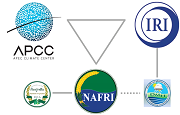
Rain-fed rice accounts for a critical percentage of agricultural production in Laos, making the country vulnerable to the impacts of climatic variability and change; a failure in rain-fed rice could have catastrophic ramifications for the economy and national food security. However, this reliance on rain-fed rice also provides an opportunity to build impactful agricultural resilience through a highly specialized project. To reduce climactic risk, this project integrated historical weather data and sophisticated climate forecasts with locally-calibrated agricultural models to provide tailored information that shows agro-climate advisory. This approach is followed by capacity building activities among relevant institutions, such as the Department of Meteorology and Hydrology (DMH, Laos) and the National Agriculture and Forestry Research Institute (NAFRI, Laos), as well as local farmers, to ensure optimized usage of the output and sustained benefits for the country. The project involved international collaboration with the APEC Climate Center (APCC, Republic of Korea), the NAFRI, and the International Research Institute for Climate and Society (IRI, U.S.). In particular, this project has five major tasks: (1) tailoring seasonal to sub-seasonal climate forecasts to Laos and the target area; (2) producing distributed precipitation data at a high resolution; (3) translating climate forecasts to agricultural information and evaluating benefits of forecast-based agricultural decision making; (4) developing a mobile application for agro-climate advisory, based on seasonal to sub-seasonal climate forecasts; and (5) stakeholder engagement and training. Local stakeholders will be consulted and engaged throughout the project to identify needs and develop a practical output, helping to ensure relevance and sustainability. These five major tasks are planned to be conducted in two years (2017.1.1.-2018.12.31). The findings of this study will be reflected to the activities of the second year which ultimately aims to develop a semi-operational agricultural climate risk management system in collaboration with the APCC, DMH and NAFRI (Figure 1).
Materials and Method
Figure 1 depicts the major partner institutions involved in this study. In this report, we present on the first year tasks and their results. We attempted to compare three crop models (AquaCrop, EPIC, and CERES-Rice) for five rice cultivars (TDK1, RD10, RD4, Kodeo, and TSN2) in wet season lowland rice production systems in Laos. For this comparison, the three models were calibrated and validated for the five rice cultivars with the observed rice phenological data, agricultural management practices, and rice yields collected form the rain-fed lowland rice environment in Savannakhet Province. This study region is located in the lower central agricultural regions of Laos (15.833 – 17.167 °N, 104.667 – 106.833 °E). The remotely sensed vegetation status (e.g., NDVI/EVI or LAI) at critical crop growth stages were also assessed as a good indicator of crop yields at harvest. These results will be used to establish crop yield outlooks next year.
The predictability of rainfall statistics around monsoon onset and of onset date over Laos was analyzed based on seasonal and sub-seasonal (S2S) forecast models in this study. We defined onset date here as the first wet day of the first seven-day wet spell, not followed by a long dry spell. The APHRODITE rainfall dataset (daily, 0.5 by 0.25° degree resolution, 1951-2007) was used to determine seasonal (MMJASO) rainfall and rainfall onset date for Savannakhet (represented by a box encompassing the 16.375 - 16.875 °N, 104.625 - 105.125 °E). We investigated various variables including geopotential height, specific humidity, zonal and meridional wind, and vertical velocity at three atmospheric pressure levels (850 hPa, 500 hPa, and 250 hPa).
Figure 1. Partner organizations and project framework. APCC: APEC Climate Center (Republic of Korea), IRI: International Research Institute for Climate and Society (U.S.), NAFRI: National Agriculture and Forestry Research Institute (Lao PDR), DMH: Department of Meteorology and Hydrology (Lao PDR), DOA: Department of Agriculture (Lao PDR).
Results and Discussion The three crop models (AquaCrop, EPIC, and CERES-Rice) were used to simulate rice yields in wet-season lowland rice production environment in Savannakhet province and the responses of climatic variables and agricultural managements to rice yields were compared in this study. The simulation results of those models showed that the EPIC model slightly underestimated in 2007 and overestimated in 2008, while the AquaCrop and CERES-Rice models slightly overestimated the rice yields in both years. A further study on experiments with no water and nutrient stresses for rice yield is suggested to accurately calibrate those process-based crop models. The values of goodness-of-fit measures for those three crop models lead us to believe that the AquaCrop model better performs than the other two crop models. However, it should be noted that the AquaCrop model might not be an adequate model to assess detailed agricultural management information, considered as best management practices to reduce climate-related risks on rice productivity.
The results from the predictability of onset date for the Savannakhet region indicate that the regional geopotential height and specific humidity fields in particular have the potential to be used operationally to improve the predictability of total seasonal rainfall as well as late monsoon onset (post April 25). The potential was higher especially when these variables were used in conjunction with changes in the regional circulation (prevailing wind field). We investigated the potential of climate variables as an indicator of rice yield outlook. The findings from the investigation showed that the relationship is sensitive to definitions of onset dates. In Savannakhet, rainfall amount and frequency in vegetative stages (MJJ) positively affected the rice yields, while negatively in late growing season. Dry spell showed opposite results: positive correlation in reproductive and ripening stages (ASO) and negative correlation in vegetative stages. From the investigation of the value of monitored vegetation information from satellite for crop yield outlook, we found that in general EVI was more useful than NDVI in predicting yields.
Conclusions
The Laos economy will benefit from continued legislation, policy measures, and capital investment to support the agricultural sector, which is a key sector for establishing sustainable and inclusive economic growth, particularly in the early stages of economic development. The findings in this paper suggest that a simple crop model like the AquaCrop model can be useful to predict attainable yields under no stress conditions (i.e., water, fertility, and salinity stresses), and that a more complex crop model like the CERES-Rice model can be useful to assess detailed agricultural management information to determine best management practices for the achievement of the targeting rice yields. The findings from this study indicate that skillful S2S forecast at different rice growing stages would be able to serve as in indirect indicator for rice yield outlook. We concluded that based on these first year results, this study can be useful for the reduction of the climate-related risk managements in rain-fed lowland rice production ecosystems in Laos and for the improvement of the livelihood of the rural people of Laos, and subsequently for the enhancement of food security in Laos.